Measure what
nobody ever
measured.
An academy player who moves badly gets told. A grassroots player who moves the same way finds out when something tears. The difference is not talent. It is whether anyone was watching.
Runs on your phone · nothing uploaded · no account
What never gets measured never gets better.
Professional clubs screen movement constantly — force plates, camera rigs, a biomechanist watching for the pattern that predicts an injury before it happens.
Everyone else trains on feel. You find out your knee was collapsing inward on every landing at the moment it stops working. Not because the knowledge is missing — it is well-established research — but because the equipment that applies it costs more than a season of fees and lives in a building most players will never walk into.
It watches how you actually move
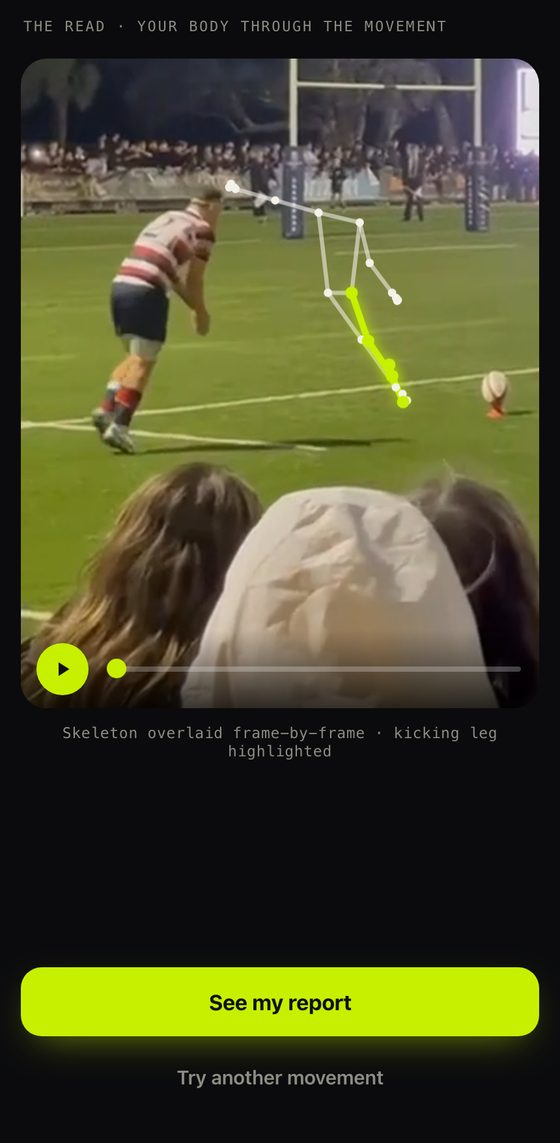
Thirty-three points on your body, every frame, through the whole movement — hip, knee, ankle, plant foot, torso.
Numbers, not a vibe
Angles and distances you can argue with. Not “looked a bit off” — a measured value, and what it should be.
One thing to fix
Ranked worst-first with drills. A list of forty faults helps nobody. One change you can make this week does.
One club pays.
One kid doesn’t.
Screening should not be a thing you can afford or not afford. So the people who can afford it pay for the people who can’t — and that is the entire business model, not a charity line at the bottom of the page.
Clubs, coaches, academies
Squad dashboards, season tracking, side-by-side comparison. The tools a coach needs to manage thirty players instead of one.
funds
The club that could never buy it
Indigenous and remote community clubs, carried on the paid side of the business — where the gap in the numbers below is widest and nobody is coming to close it.
The commitment, in plain terms: a paid feature never makes the read worse. No degraded free tier that hides the number it just measured, no ads, no holding a result back until you upgrade. Every clip that gets analysed gets the whole answer.
FormCheck is a paid product — that is what makes the other half possible. What paying buys is squad management for people managing squads. What it funds is a fifteen-year-old at a remote community club getting the same read as an academy player, at no cost to them.
Injury does not fall evenly.
Neither does the help. These are the numbers that decided both the price and who it is built for.
Sources: musculoskeletal equity study, Queensland Health — publish.csiro.au/AH/fulltext/AH24063 · Australian Physiotherapy Association — australian.physio. Figures as published; the workforce figure is 2012 and is the most recent I could verify.
A tool with a price on it re-draws the line the research already describes. That is the whole reason the model is the way round it is.
Film it.
Read it. Fix it.
Film one movement
Side-on, phone level with you, whole body in frame, three to six seconds. A goal-kick, a landing, a squat. One clean repetition reads better than ten rushed ones.
It reads every frame
Pose estimation finds your joints in each frame and tracks them through the movement. It runs on the phone itself — the clip never leaves your device, which is also why it works with no signal at a country ground.
It turns movement into risk
Plant stability, foot placement, knee extension, follow-through, torso lean — the patterns injury-biomechanics research associates with load going through tissue that should not be carrying it.
You get one thing to work on
A ranked report, worst fault first, with drills attached — and an honest note on what it could not see.
A real measurement,
off a real clip.
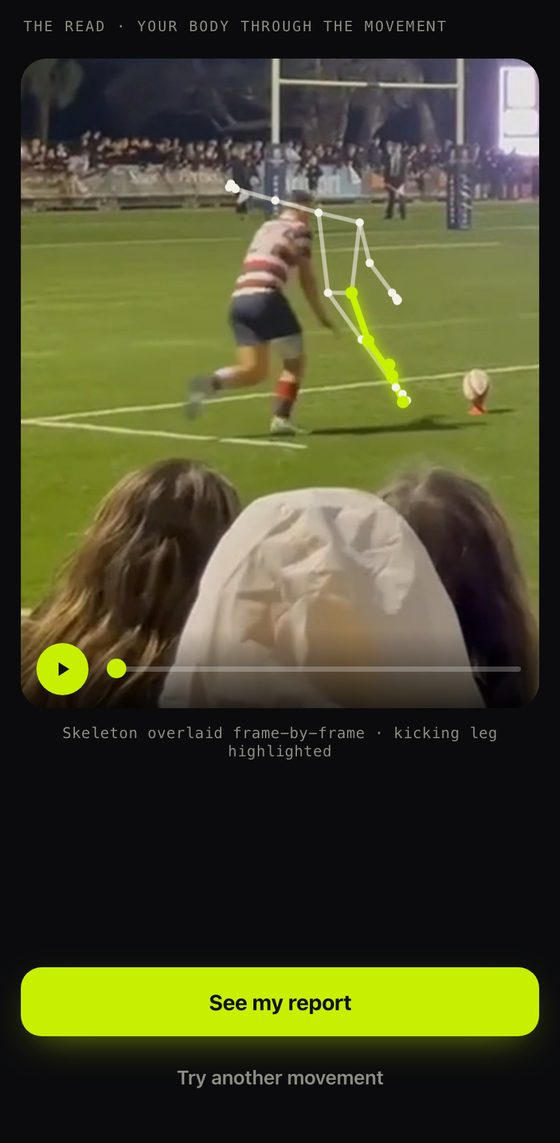
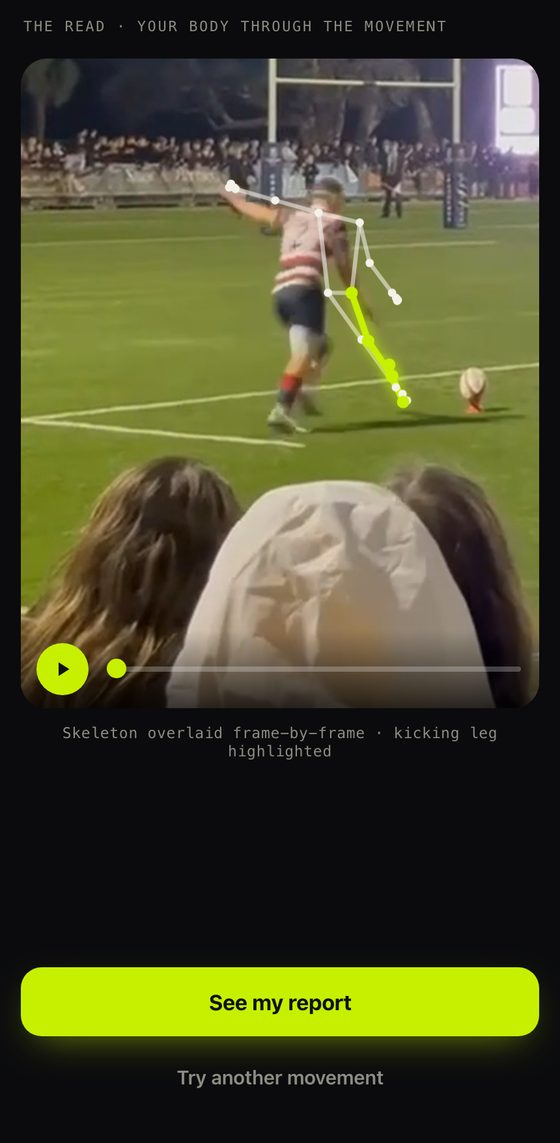
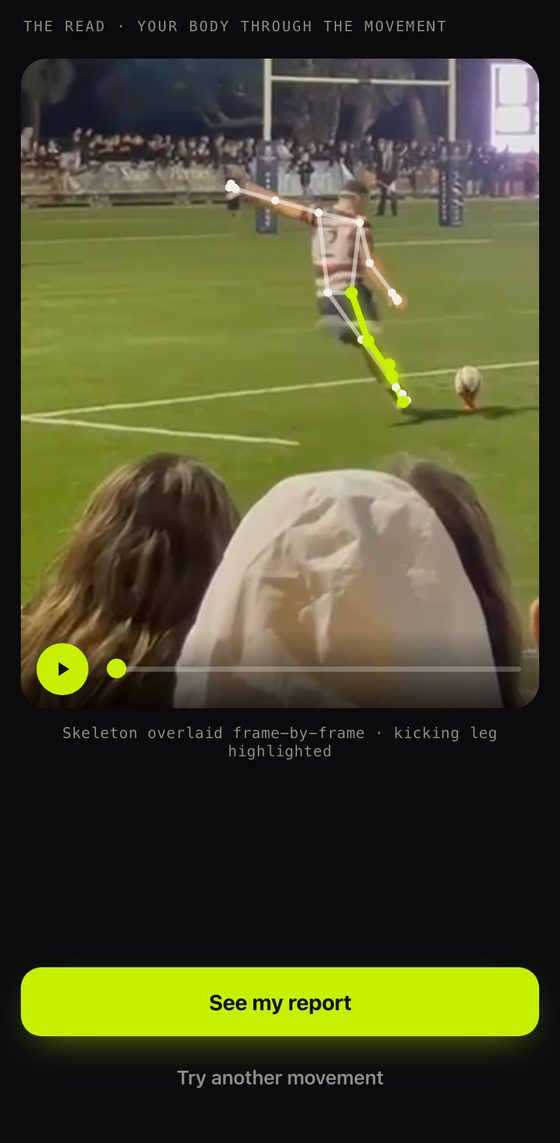
Not a mock-up. A rugby goal-kick filmed on a phone at a floodlit night match, from the side of the field, put through FormCheck unedited. The skeleton at the top of this page is that clip’s actual tracked motion.
Technique score 50 out of 100 — some work to do. Top fix: the non-kicking foot is moving through contact. A kick is built on a still base. When the plant slides you leak power and direction, and the load has to go somewhere else.
Then two drills. Plant & Pause — walk in, plant firmly beside the ball pointing at the posts, freeze one second, then strike. Ten times. The Plant Spot — mark exactly where the plant foot should land and hit it every approach. Fifteen times.
already exists.
The access
does not.
None of the biomechanics here is new. Which movement patterns load which tissue, and what that does across a season, has been studied for decades and is well understood by the people who own the equipment.
What has never existed is a version a fifteen-year-old at a country club can point a phone at. Not a cheaper lab — the first honest read most players will ever get of how they actually move.
Straight answers.
Does my video get uploaded anywhere?+
No. The analysis runs on your own phone. The clip never leaves the device, there is no account, and there is nothing for anyone to leak. It also means it works with no signal.
Is this about kicking, or about injury?+
Injury. The kick is how it is demonstrated. The same faults that cost you distance and accuracy — an unstable plant, a foot landing behind the hip line — are the ones that put load through the wrong tissue. Technique and risk are largely the same conversation, which is useful: players will film a kick to get better, and get screened as a side effect.
How does “one club pays, one kid doesn’t” actually work?+
Clubs and coaches pay for squad tools — multiple players, season tracking, comparison over time. Individual players never pay for the screening itself.
The paid side funds delivery into community and Indigenous clubs: getting it into hands, showing coaches how to film, and keeping it working on old phones and bad connections. That last part is most of the real work and it is not free to do.
Will it work on a bad phone, at night, from the sideline?+
Often, yes — that is deliberately the footage it was built and tested on, not lab video. But it has limits and it will tell you when it has hit one rather than guessing.
Which sports?+
It started with the rugby goal-kick, because the plant leg is where the load goes and it is a movement thousands of players repeat weekly without anyone watching. It has since been extended to a second sport, which was the real test — if the method only worked on one movement it was a trick, not a tool.
Know how you move.
One clip. Three to six seconds. Side-on, whole body in frame.
In your browser · nothing to install · nothing leaves your phone